
Christian Caillard (1899–1985)
Painter, watercolourist, engraver and lithographer. Member of the Painters of Poetic Reality group.
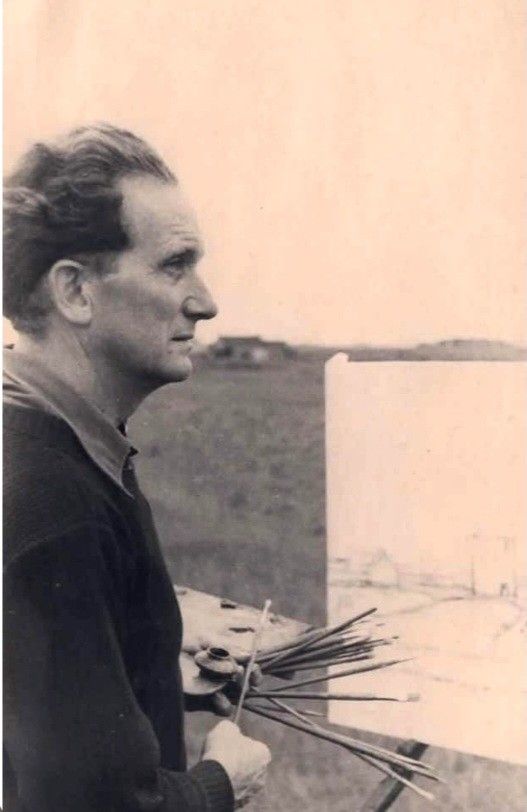
Christian Caillard, 1899–1985
Christian Caillard is exemplary in his particular sensitivity and his humility before the canvas, across his travels, his figures and his still lifes. He painted with rigour and economy of means, with precious, sophisticated harmonies that could seem rudimentary. He painted daily, with sincerity and inner faith, striving to capture as closely as possible the beauty and subtlety of what he observed. His work resembles him.
The Artist's Words
"I seek to express human feelings through the simplest, most direct and purely pictorial means — through colour and light."
"I distrust all formulas. I am certain that nature exists."
"My masters are Van Gogh, Utrillo, Manet — through whom I rediscover Goya."
"I love simple colours in their pure state. I detest literature in painting."
"Painting must owe everything to itself."
"For me, painting is nothing but human resonance."
Words recorded on 9 February 1945 by André Warnod
Biography
Descended from a line of artists, Christian Caillard grew up on the Butte Montmartre. His mother, Huguette Mendes, a teacher, was the daughter of Augusta Holmes, a musician, and Catulle Mendès, a writer and poet. His father, Gabriel Caillard, was a writer. His uncle, Henri Barbusse, gave him his first paint set.
After studying at the Collège Rollin, he sat the entrance exam for the École Centrale. Mobilised in 1918, he served in the artillery, but on returning to civilian life decided to abandon science and devote himself to painting.
In 1921, Caillard enrolled at the Académie Biloul for a few months and met Eugène Dabit, future author of Hôtel du Nord, and the painter Georges-André Klein. In 1922, at the Lapin Agill, he met Irène Champigny.
With Dabit and Champigny, he took up batik-making and accepted a commission of 300 metres for the Galeries Lafayette, turning their studio into a craft workshop. With the proceeds, Champigny and Caillard rented a former linen room on the rue Saint-Anne and transformed it into a gallery — the Galerie Champigny. Caillard exhibited there alongside Klein, Dabit, Béatrice Appiat, and soon Maurice Loutreuil. Together they formed the École du Pré-Saint-Gervais.
Caillard met Maurice Loutreuil in November 1923. It was a revelation. He would say: "This encounter lit up my youth and shaped my life." Loutreuil became not only a master but also a friend and guide. At his death in 1925 he left Caillard his canvases and his studio at the Pré-Saint-Gervais.
A decisive chapter in Caillard's career as a painter came with his first stays in Morocco in 1927–1928, a fertile source of inspiration. Encouraged by this experience of displacement, he began a world tour in 1933, staying at length in Indochina, Bali, Bora-Bora and Martinique.
His travels led him to focus ever more closely on questions of light. He immersed himself in the landscapes and customs of the countries where he lived, filling many notebooks with sketches and watercolours that bear witness to his encounters and sensations. He always painted from life, in direct emotional contact with his subject, driven by the desire to convey the beauty and vitality of what he perceived.
Back in France, he received the Blumenthal Prize in 1934. In 1935 he settled in a studio in the 9th arrondissement of Paris at 6, rue Clauzel — a stone's throw from the little shop where père Tanguy had sold colours to the greatest artists: Van Gogh, Pissarro, Gauguin, Cézanne, Monet, Renoir. There he brought back the canvases he had "harvested" across the world.
Mobilised in 1939, he was taken prisoner in the Vosges in 1940. Released in June 1941, he resumed painting, dividing his time between Brittany, travels abroad and his Parisian studio.
In 1949, with seven fellow painters — Maurice Brianchon, Jules Cavaillès, Raymond Legueult, Roger Limouse, Roland Oudot, André Planson and Kostia Térechkovitch — he formed the group of Painters of Poetic Reality, one of the most original groups in mid-twentieth-century French art.
During his career, Caillard also created murals for national museums and illustrated works by Colette, Francis Carco, and editions of the Histoire de France and La Fontaine's Fables.
Until his death, Caillard continued to travel the world: Morocco, Mexico, Greece, Spain — where he acquired a house in 1956 at Javea near Alicante. He spent a further year in Madagascar in 1964, then Ceylon in 1970, Bora-Bora and Bali in 1973, Tunisia in 1974, Mexico in 1976 and Nepal in 1979.
In his final years he divided his time between his Spanish home, the island of Ouessant — whose shifting light and desolate moorland he loved — and his Parisian studio in the 9th arrondissement. He died there on 18 September 1985.
After his death, the Galerie Jean-Pierre Joubert paid tribute to him in Paris in June 1986. The city of Menton received him in April 1987 at the Musée des Beaux-Arts of the Palais Carnolès. In 1997, the city of Paris devoted a major retrospective to him in honour of his role as painter of the 9th arrondissement.
Critical Voices
Thanks to a lucid fervour and scrupulous humility, Christian Caillard helps us to penetrate a poetry made of mystery and overwhelming light, without ever resorting to the easy seductions offered by the settings of these countries. The deeper virtues of this painting lie elsewhere. It obliges us to stop, to reject the gratuitous games of which so many have made us witnesses, and to rediscover, through a body of work that is consistent beneath all skies, human beings.
A reflection of his emotions and a testimony to his encounters, his work illustrates his interest in the human figure.
I love painting and true painters — all those to whom a privileged gift endlessly reveals the marvellous secrets of the sensory world given to us.
Caillard asserts himself in figures and landscapes, with a taste for effects of light but also for nuance and the brilliance of colour.
Murals
A large panel depicting oil fields at the foot of the Carpathians, for the Musée de la Découverte, Paris.
Nine panels dedicated to the glory of comedy, for the small Foyer de l'Odéon, Paris.
Five frescoes depicting the main episodes of the life of the Buddha — birth, betrothal, temptation, bathing and death — for the Conference Hall of the Musée Guimet, Paris.
Illustrated Books
- Colette, Belles Saisons, Éditions de la Galerie Charpentier, 1946
- Francis Carco, Mortefontaine, Cercle Lyonnais du Livre, 1950
- Histoire de la France, Club du livre, Éditeur Philippe Lebeau, 1963
- Fables de la Fontaine, préface par Jean Cocteau. Éditions Jaspard, Polus et Cie, 1961
Gallery


Avec Maria Casares années 50